Over 60 care and education champions joined Lifelites for hands-on assistive technology training featuring Smartbox, Soundbeam, and Cosmo.
Meet Gideon Schulman: Supporting Lifelites Through Charity, Business and Inclusion
Meet Gideon Schulman: Supporting Lifelites Through Charity, Business and Inclusion
Gideon Schulman is a Freemason, business leader and charity trustee. He is also a supporter of Lifelites, the charity providing assistive and sensory technology to children with life-limiting conditions. In this interview, Gideon discusses his connection to Lifelites, the role of Freemasonry in his life, the importance of disability inclusion and why he believes businesses have a responsibility to support charities.
Who is Gideon Schulman?
I am a husband, father, rabbi, Freemason, charity trustee and business leader. Much of my working life has sat where people, governance and responsibility meet: HR, charity leadership, safeguarding, organisational change and helping people through difficult decisions.
I also live with advanced multiple sclerosis and use a wheelchair. That is not the whole of who I am, but it has shaped how I understand dignity, independence, inclusion and practical help. I have learned, sometimes the hard way, that good intentions are not enough. People need support that works in real life.
When did you become a Freemason?
I was initiated into Freemasonry in May 2013, so I have been a Freemason for more than thirteen years.
What drew me in was the mixture of tradition, friendship, moral seriousness and service. I was not looking for another social diary entry. I was looking for a place where ritual still means something, and where men are asked to think about character, duty and how they conduct themselves when nobody is watching.
What does Freemasonry mean to you?
Freemasonry has given me friendship, discipline and a language for self-improvement that is both old and still practical. It has also given me a community where people from very different backgrounds can sit together with a shared sense of respect and purpose.
Personally, it has helped me keep showing up, even as my health has changed.
Professionally, it has reinforced lessons I already believed in listen properly, keep your word, serve before you seek status, and take responsibility for the effect you have on other people.
Why do you support Lifelites?
Lifelites brings together several things I care about deeply: children, disability, communication, technology, family life and practical kindness.
For children with life-limiting conditions, technology is not a luxury. It can be the difference between being present and being left outside the conversation. It can help a child play with a sibling, speak to a parent, enjoy a moment of control or simply be part of ordinary family life.
As a disabled person, I know how much independence can depend on the right piece of equipment at the right moment. As a Freemason, I also recognise Lifelites as a charity with a strong Masonic story and a clear human purpose. That combination matters.
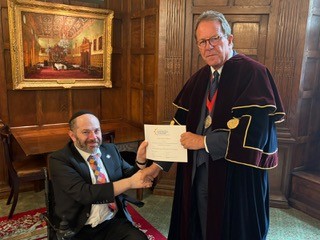
About Pytronot and Gideon Schulman’s role.
Pytronot is a payroll and accountancy business built around a simple idea: people should be able to trust the numbers, the process and the advice they are given.
The business was created to provide practical payroll, accountancy and business support without making clients feel small, confused or spoken down to. Payroll is sometimes treated as a back-office function, but it touches people very directly. If pay is wrong, late or badly explained, trust disappears quickly.
Our team brings together technical payroll and accountancy knowledge with a strong service ethic. We work best when we are close enough to understand the client, but disciplined enough to keep the process accurate, compliant and calm.
My role is to oversee the strategic direction, client approach, people matters and wider leadership of the business. In plain English, I help make sure Pytronot grows in the right way and stays true to the standards we expect of ourselves.
That includes governance, culture, service quality and how we support both our clients and our own team. I am interested in the kind of business we are building, not only the work we process.
How did Pytronot come to support Lifelites?
The connection came naturally because Lifelites sits so closely with our values. It is practical, human and focused on removing barriers, not simply talking about inclusion.
From a personal point of view, I understand how technology can preserve dignity and independence. From a Masonic point of view, Lifelites is part of a long story of service. From a business point of view, its work is specific, measurable and deeply human.
Why should businesses support charities?
Businesses do not exist in a vacuum. They rely on trust, stable communities, healthy relationships and people who believe that institutions can still do some good. Supporting charities is one way of taking that responsibility seriously.
It should not be treated as a marketing trick. The best charitable support is rooted in values, relationships and usefulness. A business should ask: where can we make a real contribution, and are we prepared to stay with it when it is no longer convenient?
Some people would place that under ESG or corporate responsibility. I prefer to think of it more plainly: a business should know what it stands for, how it treats people, and where it can do some good.
How does Pytronot approach charitable giving?
Our approach is deliberately practical. We are not trying to create a glossy CSR programme that sounds better than it is. We want to support causes where there is a real connection, a clear need and a meaningful use for the support.
That means we are drawn to charities that strengthen dignity, independence, community and opportunity. Lifelites fits that approach because its work is not abstract. It places technology directly into settings where children and families can feel the benefit.
What are the benefits of businesses supporting charities?
The main benefit is moral clarity. Supporting a charity reminds a business that success is not only measured by turnover, margin or efficiency. Those things matter, of course, but they are not the whole account.
It also strengthens culture. People want to be part of organisations that have some sense of purpose beyond themselves. When charitable support is done honestly, it gives colleagues, clients and partners something decent to gather around.
Why is the partnership between Pytronot and Lifelites important?
For me, the strongest part of this story is the overlap between Freemasonry, business responsibility and disability inclusion.
Lifelites is not charity in the vague sense. It is practical help, delivered through technology, to children and families facing some of the hardest circumstances imaginable.
That is why the story matters. It shows what can happen when tradition, business and compassion are not kept in separate boxes but are allowed to serve the same human purpose.
Similar posts
At 72, John Donoghue cycled 800 miles across Spain in record heat, raising over £2,000 for Lifelites. Read his inspiring story and support children with life-limiting conditions.
Lifelites 25 has won two major charity awards in 2026, recognising its innovative approach to reaching more children with assistive technology.